08 June 2013

Look At It: Don't Blink, Don't Smoke

I am renting the TV series "Mad Men" from Netflix while attempting to stop smoking cold turkey.

At a time and in a place where I feel reduced by circumstance to two primary pastimes as go-to sources for psychological and intellectual stimulation and sustenance:  writing and playing piano -- both activities that have been closely pegged to cigarette smoking for the last 40 years of my life.

It's been noted before (on this blog and elsewhere) that for smokers, cigarettes are like friends. Best friends really because of their uncomplicated, non-judging loyalty and reliability. Who/what else has been there no matter what, rain or shine, in sickness and in health, good times and bad?

Here's a paradox of the relationship:  this friend can in one moment grant a compelling insight that sparks creative invention (so much of the writing here has come this way); but over the long haul, for most of the days and nights of the relationship, this friend suppresses feeling, hiding me from Truth and Truth from me.

In "The Shitty Handshake," the second gritty portrait in Paula Bomer's  Baby and Other Stories, a woman quits drinking. Or tries to quit drinking. With some weeks of sobriety under her belt, she abandons polite convention with her sister-in-law for the first time and tells her the truth. The sister-in-law invites her to join the family for a holiday getaway.
"Thanks, Alexis. But I don't think I can make it. You should check with Dan, though. I'm sure he would love to go."
"You have other plannz?"
"Actually, no. I just don't think I'd be comfortable, but thanks. You have Dan's work number, yes?"
... "You wouldn't be comfortable?" Karen could hear her sister-in-law adjust her headband.
"No."
"I'm sorry. But why not?" ...
"Because I'm not comfortable around you and your family."
Silence.
"I'm sorry." Alexis said, with absolutely no conviction. Indeed, it was one of those sorrys that really meant fuck you.
"No need to be sorry. I'm just not comfortable around you and there's nothing either of us can do about it."
"Well, but why not? We're always so happy to have you," she lied.
"Because you are a bitch and a snob."
"I beg your pardon?"
"I'm not comfortable around you because you're a bitch and a snob. There's nothing anyone can do about that at this point. It's just who you are, what you are. A bitch, and a snob." Karen's ears started to ring. A current of electricity surged through her and the lights in the kitchen flickered. The truth was that powerful. ...
When she got off the phone, she was so high she realized she didn't need booze. No, she just needed to tell the truth. It was such a rare thing, the bald truth, especially since she'd gotten older. Of course, the feeling wore off, just like the effects of alcohol do. ...
Bomer, Paula (2010-12-15). Baby & Other Stories (Kindle Locations 286-294). Word Riot Press. Kindle Edition. 
I know this "high". It's unpredictable and uncontrollable. Just every now and then, taking a deep breath like any other deep breath and SURPRISE! -- on the out-breath all traces of uncertainty or artifice leave me. I see myself and the world around me with an uncommon clarity. And if you ask me anything in that moment, I am powerless to respond with anything besides plain, uncontaminated honesty.

It is strange, how separation from my "best friend" -- paradoxically the same "best friend" who carries the words and ideas and feelings I need for inventive creative work -- sets the stage for transcendent vision and truth-speaking. [Researchers are looking at this and related phenomena through less romantic lens; they study "the effect of nicotine on brain activity."]

*******%%%%*******

In part because I'm missing my "best friend"
and in part because after 10 months in Holly Springs I am still essentially an outsider here and spend most of my time alone
and in part inspired by Bomer's brilliant narratives about the interior life of Introverts

I'm thinking about alone-ness lately. Thinking that feels sane, stripped of nostalgia and emotion. 

A big new idea: seeing my family as a clan of loners, a bunch of people related by blood who could not (why?) forge strong social bonds with each other. Examining my lone-wolf nature as a learned, socialized characteristic. Wondering if any of this is transmitted genetically.

I don't know how far I can go with this investigation 

without smoking.

It's like I need my Friend to hold my hand while I face the truth about what kind of Friend s/he is. 

It's like only without my Friend can I see how alone I am and fully feel that alone-ness and wonder about it...but I need my Friend's company to think deeply or do any writing about the process.


This is boring.

04 June 2013

Re Frame

yeah

I woke up the other morning to this thought

If I live as long as Mommy, I'll be dead in less than 20 years

 Wow. The thought quietly rocked my world for a few days. An exhilarating sense of freedom came over me: And excitement. And curiosity. 

Remarkable how one thought changed my perspective on EVERYTHING. And the longer I looked at Life through that lens, the calmer I felt.

And then, one day, a new thought intruded:  

If I live as long as Mother, I have more than 40 years of living left....a whole 'nother lifetime...

Wow

So I  tossed the cigarettes and decided it's time to "quit" again. 

Not smoking always changes my perspective on EVERYTHING because my "friend" is gone

and I have all these scattered minutes to fill with ....something

and there's more oxygen fueling the System

and I have no protection from the thoughts and feelings that smoking helps suppress. For example:

With all due affection for my descendants, having a baby was a bad choice.

Here's another one:  I didn't come to Holly Springs with a great idea. I came to Holly Springs because my friend invited me to come create something with him and because I was tired of hustling for survival in the SF Bay area. 

yeah,  everything is lit by a very stark, unflattering light in the first days of a Quit. I kinda like it. 

I can't write but I can see.


26 May 2013

Get on the Bus

It was almost 3 am when I turned off the light this morning.

I dreamed I went to a popular all-night diner with a friend after a great show. We sat at a table in the front window. Conversation was lively and far-ranging. The place was packed and noisy. I'd wanted to eat here for a long time. As my eyes scanned the huge room, I spotted several people I knew from Louisville and Oakland and New Orleans and other places. Amazing to find people from all over the country in one place. I mingled, sitting at first one table and then another for a few minutes of laughter and talk. 

Gradually, I became aware that everyone was eating except me. What was the protocol here for getting some food? I set my mind to answering that question and discovered a long, long line that started somewhere near the middle of the building. I joined the queue, talking amiably with people I didn't know as we advanced. The line moved quickly. I was surprised when I reached the cash register:  I still had no food.  I left the line and retraced my steps. 

Somewhere in the middle of the line sat a high counter with a plexi-glass top and copious scuff marks covering its face, as though a lot of struggle had taken place. A youngish man and an old woman were dressed in white and more focused on each other than the customers but I soon figured out they were the ones taking orders and making food. It was necessary to talk loud and look upward to place an order. "What do you want? Biscuits? Sausage? Gravy?"  "Yes," I said. "I'll have biscuits with sausage gravy." "We don't have that," barked the young man. "But you said...."

We spent several minutes in confused, circular conversation before it finally seemed he had my order.  I stayed in line. I reached the cash register and, again, I had no food. This time Henrietta Alves was also there without food. We were the only two in the restaurant who had no food. "I've had such a good time," I told her. "But I am starving. How do we get food here?" She was angry but gracious as she complained to the cashier. I was desperate and frightened and very very hungry....growing weak....and I woke up.

At 7:04 a.m. Feeling tired and hungry.

The dream has moved me to get dressed and find the nearest UU church (one of which happens to be just outside Oxford). I've had coffee. I'm on my way there in another hour. I don't have great expectations but the dream is under my skin, driving me to "get fed" today. As I searched Google Maps for directions to the church, the thought of Batesville and the Buddhist Monastery there came to mind. I added it as a destination on the map and plan to stop there after I leave the Oxford church.

The determination I feel resonates with the photo/quote at the top, something I found on my Facebook page this morning. This hunger feels like a matter of survival. Like I have no choice now. Like the present situation is no longer tolerable and it's time to get on the bus.

23 May 2013

The Death of Mother Wood, Part 2

When my mother died last year I had the feeling of moving to the front of the line. With my grandmother's death, the feeling has returned in a more intense way. It was reassuring to hear an actor in a recent interview with Terri Gross confess a similar experience after his father died. It's difficult to describe the experience in words, which may be why I'd never heard anyone else mention it.

What "line"?

As a young child, too young to conceive of a "line", I lived with my hand in the hand of my parents as they led me through the World. Nearly every aspect of my existence relied on their guidance. Later, Time brought experiences of independent discovery -- coming face-to-face with the World on my own, holding no one's hand. For a time, though, each of these discoveries was carried back to be shared with the one(s) whose hand I used to hold so tightly. "Look what I found!" and "The clouds are moving, Daddy!" I was still being led:  their commentary and reaction to my discoveries informed future expeditions.

There was a particular summer afternoon when my siblings and I were home alone. Although this might be unthinkable nowadays, it was a small town and a safer time with minimal risks attached to leaving four kids unattended. Still, I was the oldest and wouldn't have been much younger than 9 or 10.

In the midst of some playtime fantasy world, a distracting awareness dawned that the environment was changing. The curtains began to dance in a quickening breeze through the screened windows, an alternating rhythm of being sucked flush against the mesh and then floating out into the room. The world beyond the window seemed held by a solid, lively stillness. There was no birdsong; the birds were silent in their hurried flight to shelter. The oak tree leaves, disturbed by wind, strained against their stem tethers, twisting and fluttering. Dark clouds rolled in to block the sun. The air was electric.

I can remember the excitement that overtook me. "Let's go outside!" As the oldest child, my word -- whether uttered as invitation or command -- was law. My sisters and brother eagerly followed me out the back door into the yard. We ran around squealing and screaming, our breath nearly sucked out of us as the storm approached. Within minutes it was raining. Thunder boomed and lightning exploded in long powerful branches against the sky.

In retrospect, we look like four miniature drunks:  laughing and rolling down the hill in the wet grass. We were ecstatic. Crazed by the storm. That is not how it looked to my father when he pulled into the drive. "What are you kids doing?!" he shouted. "Get in the house!"

I can't remember the substance of his intense reprimand as the four of us stood dripping wet in the kitchen. I remember the overhead light was on and the stunning contrast between the dark outside and the bright inside made it difficult to focus on what he was saying. I caught the gist: we were in trouble. It was "bad" to be taken by the storm and "bad" to be outside in the rain and wind. I would have a child of my own before I allowed myself another greet-the-storm adventure.

Eventually I ventured into more personally significiant exploration, discoveries that I did not share. Things I learned without seeking a witness to corroborate or judge. By this time, however, Authority had been internalized. I knew "right" from "wrong" Memorization of the codes, the list of what the world deemed "appropriate" and "inappropriate", was fairly secure. Pure discovery was rare; explorations were curated by the voice of an Inner Judge/Parent, an entity that embodied the entirety of my socialization to that point in time. It was no longer necessary to show-and-tell my parents what I was discovering because they lived in my head. They were still leading me. At age 16, sitting on the flood wall with a "white man" I didn't know, smoking pot for the first time, I understood I was doing something "bad" without ever mentioning the episode to any of the adults I knew.

-----@@@-------

The lives of the ones who led my life were also led. They followed stars invisible to me. Bright stars of longing and purpose that burned only in the private skies of their own hearts and minds.

They followed their stars...and I followed them.

I am talking now about roads that wind beyond the realm of social convention and practical concerns. I am talking about the urges and motivations of their Souls. The paths they took for love or avoided out of fear. The life-long journeys driven by a burning question.

I have imprecise knowing of their deepest loves, fears and questions. (I have my own deep loves, fears and questions.) Still, I think now that my life has followed, in a largely subconscious and unacknowledged way, the light of my ancestors' guiding stars. And I think I have enjoyed measures of security, protection and hope from my position, behind them in line. Never really thinking about it, taking it for granted, that someone was further down the road, having experiences, flailing in uncertainty and basking in resolutions. In advance of me, on the same road. paving the stretch ahead that lay beyond the bumpy place I presently tread.

This week, I have experienced a new kind of alone-ness. It's been partly physical:  my gray hair, sagging body, dry skin and achy joints are mine alone now. There's no one alive -- no female in my bloodline -- who is experiencing the next stage of these phenomena. I am "it". I am the primary, senior actor, the "expert" now, living out the perplexing miracle of physical aging.

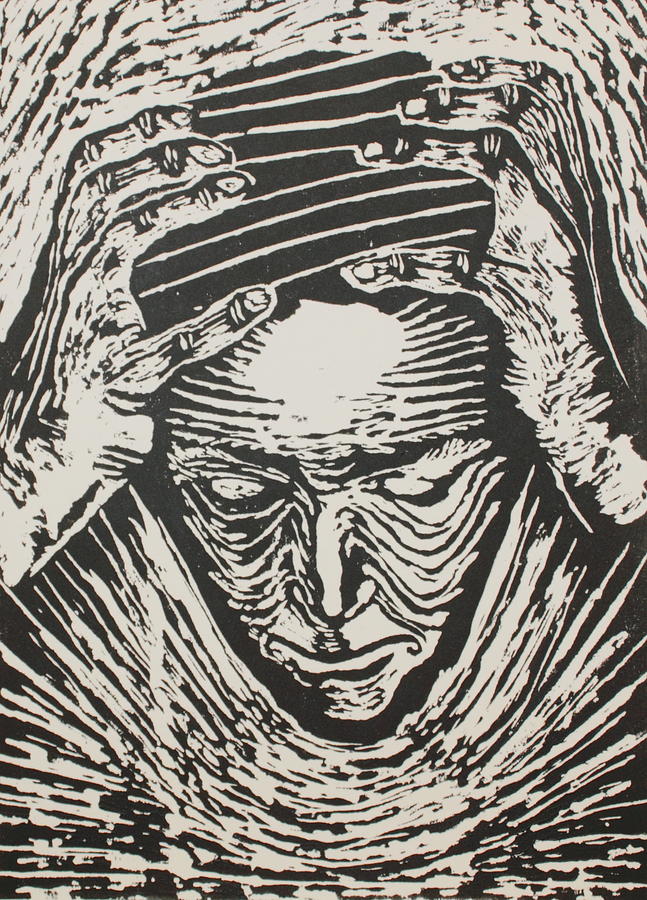
Artist:  Etienne Saint-Amant
Objurgation
In the psychic realm of this alone-ness, there are questions about Being that I hold alone now. In the end, what matters most in Life? Does there come a time to abandon certain dreams? Are there any consistencies in Life, anything Truth that persists from first breath to last? What is Death?

-----@@-----

It seems there is no clarity to be had. Something like "imagination" -- conjecture, digression, inspiration -- moves me along in the emotional and ideological jumble my grandmother's death has sparked. I discover/experience only temporary clearings, spaces wherein I embrace the confusion and lie down in exhaustion. Or stumble upon some aspect of pain or puzzlement that reminds me of someplace I've been before.

Today, I awoke with some tears as I considered that both my mother and grandmother spent their final years without a loving partner; and that my life seems to lean toward a similar final chapter. As the tears subsided, a calm came upon me. I am. I am here. The confusion, the feelings, the memories and questions are mine. They are part of the Story of Me. Part of the story.

I am not under attack by an alien force intent on blowing my mind or crippling my life. I am having a life. "A good life" by my grandmother's assessment in a card she sent me some years back. Death is a part of Life. We die and our deaths become part of the Survivors' stories. I am a survivor. At the head of the line with a new chapter in my Story.


22 May 2013

The Death of Mother Wood, Part 1

Sometimes confusion sparks my imagination. Most often this happens when my head is clear but the external environment is in disarray. I am confronted by a disorderly assortment of materials or objects or ideas and take on the task of creating a comforting, harmonious arrangement, explaining or reconciling inconsistencies; imposing order on the chaos.

Though the precipitating factor was external, the confusion I've felt since learning of my grandmother's death last week has more to do with my own emotions and thoughts. Imagination is an uninspired witness to this confusion, sits in the corner and says nothing. Reflecting on the life of my family is like opening Pandora's Box...and there's a mess inside. Full of stuff that wasn't washed before it was packed away...wasn't sorted or labeled...wasn't wrapped in tissue or folded neatly.

My grandmother was 105 years old and had been in relatively good health until the last two months. The news of her death seemed natural and timely. I was not, and am not, grief stricken. Feelings and memories are colliding inside me but grief is not part of the mix.

Nothing is clear even now, almost one week after my father called to let me know his one-time mother-in-law was dead. I see everything through a fog.  The outlines are blurry. It's like slogging through a shadowy bog, knee-deep in oozing substances of various colors and consistencies; feeling the brush of wet vegetation  against my bare face and arms -- some of it young and green and some of it decaying; occasionally startled by the hiss and cry and scream and whisper of strange creatures, hiding among the leaves and grass...above, behind, around me.


The movement of my thoughts and feelings this week has been lazy and haphazard and unguided. I'm getting nowhere. I'm writing now in search of  a ray or two of clear light, trying to "get somewhere" and make some sense of things because this kind of confusion is uncomfortable.

And beneath/behind/within the intellectual and emotional chaos, lurks (murmurs?) a suspicion that the whole process is Me trying to tell Myself something...

)))))))&&&(((((((

One stream in the current mire of confusion could be called "the unspoken":  things alluded to but not discussed outright; things omitted in contexts where mentioning seems logical or instinctive. Things in plain sight that we pretend not to see. Questions that are asked but go unanswered. It's always been this way in my family and I've always struggled with it. My grandmother's death only serves as a fresh reminder of a familiar pain.

An example:  her obituary:

Eva Mildred ‘Mother Wood’ Wood, 104; of New Albany

Funeral services for Eva Mildred “Mother Wood” Wood, 104, of New Albany, will be at 11 a.m. Monday, May 20, at Galatian Baptist Church, New Albany, with burial in Abundant Life Memorial Gardens, New Albany. She died Thursday, May 16, 2013, at Rolling Hills Health Care Center, New Albany.
Visitation will be from 6 to 9 p.m. Sunday, at the church.
"Short" if not "sweet."

Discussing Mother's unmentioned survivors, my father offered "If they named all the survivors it would take up a full page in the paper." He's right: listing the names and relationships of Mother's survivors would be a lengthy task. She gave birth to 16 or 17 children, most of whom are still living. Each of these had 2 to 8 offspring (I'm in that generation.). Most of us have an average of 2 to 3 kids (Mother's great grandchildren); and those children, including my son, have children of their own (the great-greats). Given that some in my generation started having children a decade earlier than I did, it's even possible there are a few great-great-greats. A sizable tribe of descendants.

Listing survivors would also be a daunting task since estrangement, unacknowledged "illegitimate birth" and "vanishing acts" are not uncommon in this family. We don't really know all the names...  I learned only last Spring from my father, for example, that my deceased mother, at least at the point in time where she was pregnant with me, was uncertain about the identity of her father. (This was the same conversation in which he confessed that they were not married when I was conceived and they married to legitimize my birth). I do not know if she solved that mystery before she died.

But what about her life? Some mention, if not celebration, of her life. The liveliness of riding the Earth's revolutions for over a century, holding and bearing new life more than a dozen times...all the working and playing, singing and sorrow, seems worth mentioning. Not for her but for those she leaves behind. Only a generalized hint in the number 104 and even that steals a year from her actual age by family tabulation. No mention of her membership on a senior softball team in her 80s. No mention of the strength and beauty of her whistling (not sure I ever heard her sing but boy could she whistle!)

Who wrote the obit? Who chose "Obit Lite" over a more abundant, celebratory announcement? 

Artist:  Lisa Le Quelenec
"Last Light, Southbourne"

I did not drive back to Indiana for the wake or funeral. At the hour of the funeral I was at the piano in Christ Episcopal Church in Holly Springs MS, practicing Bach and Beethoven in memory of her. My reasons for not going are nebulous, more swirling debris in this emotional quagmire.

I was born and raised in New Albany but when I make return visits no one among the community I knew then can provide lodging. I could stay in a hotel; and, as an adult I've made a couple of friends who live there or in nearby towns and could possibly host me. But there is something so profoundly albeit indistinctly disturbing to me about there being not a single open door among the people who have known me longest that I resist making return visits. It's a 7-hour drive from here. I think of making that drive, sleeping in my car at the conclusion of business and driving back and my heart hurts.

There have been no detailed discussions of the bans. The explanations offered on each of the first-and-only occasions when I inquired felt permanent, e.g., "We just never did entertain," "We don't have the space for overnight guests," "Oh, I wouldn't dream of subjecting somebody to our holy mess," etc. These explanations feel like descriptions of fixed circumstances; they prohibit revisiting the question. 

Elements of shame, anger and embarrassment swirl in the murky waters of my emotional reaction to this reality. They float far beneath the surface as fuzzy outlines with glowing eyes. I don't talk about the feelings with friends and family. I generally avoid stirring those waters. With Mother's death, the waters have been disturbed. I writhe in contemplation of "What kind of life is mine that no one who knows me welcomes me home?"

(picture discovered in FB photo album and inserted 3 months later)


15 May 2013

Ain't Afraid of No Ghosts

Last weekend, on a tip from a friend, I drove up to Byhalia to find a certain used clothing store where everything costs a dollar. I'm not fond of shopping generally but if you're talking beautiful or fun clothing for cheap, I'm ready to go.

I found the store and walked in with a wad of $1 bills ready to pick up an entire summer wardrobe. The dress racks were full but my heart began to sink within a few minutes of browsing. All of the dresses were huge. On closer inspection, it became apparent the clothing was grouped, more or less, by size and I was in the wrong section. 

Browsing the scant section of dresses in my size, my heart sank further:  there was nothing on the rack that matched my taste. Onstage, playing a Church Lady or a School Marm or a Matron or a Small Town Prom Queen, this would be the dream dressing room; but playing myself in the real world? 

I kept looking and eventually found a long sheath in a slightly-African-looking fabric. On a shelf full of linens, I found a long sheer curtain that would work in the kitchen. At the cash register, after I paid for both items, the elderly clerk offered me a free religious tract -- not Daily Word but something like it. I gently declined and left the store. The full bright sunlight of my arrival had turned overcast by the time I reached my car. I glimpsed my face in the rear view mirror as I backed out -- I was scowling. NPR's Saturday afternoon programming was irritating; I turned off the radio and rode home in silence.

%%%%%%%%%%%%%

Earlier this evening, I popped today's delivery from Netflix into the DVD player. Misery. Five hours later, I am less than 20 minutes into the film. I've seen it before. The first time was back in the 90s, a few days after my adolescent son moved to Kansas to live with his father. I rented the cassette the afternoon before he left but had been scared to watch it that night...or the next night...but, feeling somehow obligated not to waste my investment, finally found the courage to watch it during daylight hours before rental time ran out.

It was a disturbing film. A scary movie. And, judging from my behavior tonight -- watching for a few minutes and pausing to wash dishes...returning to watch for a few minutes and pausing to make dinner....returning for a few more minutes and pausing, again, this time to play Internet backgammon for awhile and write this blog... -- this movie still scares me. Why did I order it from Netflix? I don't know.

I started thinking --during yet another pause, this time for a cigarette on the back porch -- this is an unfamiliar feeling. I am not often afraid. What else instills me with this kind of fear, real fear? I wondered.

I mentally scrolled through a list of  the things that people frequently say they fear:  ghosts, public speaking, heights, enclosed spaces, snakes and spiders...  These are scary, I guess. I think I could write a story and employ some of these as scary elements. But neither thinking about nor encountering snakes or heights make my heart race. I don't have a physiological reaction to the thought or the real experience of speaking in public.

I have a physiological reaction to the mere thought of Misery. And I become so mentally and physically uncomfortable when watching it that I have to pause the film and leave the room.

When have I felt like this before? I asked myself.

And then I remembered:  it was last Saturday! Driving home from the thrift store. Browsing through racks of dresses and slacks and blouses discarded by my new community of residence and finding nothing that I would wear scared me. Maybe it was partly the strangeness of leaving virtually empty-handed, after a lifetime of gorging myself in thrift stores; but it was more than that, too.

I have never thought about it before but clothing reveals something of the ethos of a community. Similar to the way that the absence of a bookstore or coffee shop here leaves me disoriented and not-quite-at-ease, the thrift store offerings say Girl, you are out of your element here.

I find I am not nearly as worldly as I might have thought. I ain't afraid of no ghosts but take away my books and my funky old clothes and I start shaking in my boots.


12 May 2013

NPR's Michel Martin Interviews Harvard's Humanist Chaplain Greg Epstein

Last week I heard an interview on NPR that left me gritting my teeth. On the occasion of the National Day of Prayer, Michel Martin interviewed Greg Epstein, the Humanist Chaplain at Harvard University. The premise of the interview seemed flaky but in the hands of a skilled interviewer with a commitment to intelligent journalism, there was hope.

The hope was not fulfilled. In fact, it fell so far short of fulfillment that a week later I am losing sleep (it's 3:30 a.m.) to listen again and annotate the transcript. Click HERE if you want to hear the interview in its entirety. The abbreviated transcript appears below with comments as footnotes.

Humanists On Surviving Crisis Without A Prayer
May 03, 201312:00 PM

Thursday was the National Day of Prayer, and the president called on people of all faiths to remember the victims of recent national tragedies. But what about the growing number of Americans who don't pray? Host Michel Martin speaks with Greg Epstein, the Humanist Chaplain at Harvard University, about where people without faith turn for comfort.

Copyright © 2013 NPR. For personal, noncommercial use only. See Terms of Use. For other uses, prior permission required.

MICHEL MARTIN, HOST:

… it's time for Faith Matters. That's the part of our program where we talk about matters of faith [A1] and spirituality and today is a good day for this conversation because the National Day of Prayer[A2] was observed yesterday. It was created in 1952 by Congress and signed into law by President Truman[A3] and the day is meant to convey the importance of prayer[A4] and to encourage prayer[A5] , and all this probably comes at a welcome time for many Americans as we continue to recover from recent tragedies like the Boston Marathon bombing and that fertilizer plant fire in Texas.

But that got us to thinking. What about people who do not pray? According to the Pew Forum on Religion and Public Life, those who say they do not belong to any religion or worship any deity are the fastest growing faith group[A6] , if we can call it that, in this country. We wanted to talk more about this, so we've called upon Greg Epstein. He is the humanist chaplain at Harvard University and he's the author of the book, "Good Without God: A Billion Non-Religious People Do Believe."

Welcome to the program. Welcome back, I should say. You've been with us before.[A7] Thanks for joining us once again.

GREG EPSTEIN: Thanks very much for having me, Michel.

MARTIN: So, Greg Epstein, just starting with the National Day of Prayer, which was observed yesterday, I'm sure that there were events around the country or people, clergy people referred to it or had certain kinds of events. What do you do on a day like that?[A8]

EPSTEIN: Well, first of all, I don't have any problem with the idea that people are getting together to pray and even to pray in large groups or large communities around the country. I think that that, for people who are of sincere religious faith[A9] , can be a wonderful activity and it doesn't affect me in any negative way[A10] . I do have concerns when it is associated with violations of the separation of church and state.[A11]

But, beyond that, we in the humanist secular, atheist, non-religious community have made this also into ...a Day of Reason ... what's really important to keep in mind on a day like this or around these kinds of celebrations is just that we're talking about American values, so prayer and religion is one American value[A12] . It's not the only one. We're also talking about the values of being reasonable, using our human intelligence to solve problems, being compassionate, caring about other people, working to connect with people and include people and value people in all sorts of ways[A13] . ...

MARTIN: What about in times of personal or national crisis ... It's become common to have some kind of a prayer service, an interfaith service in order to acknowledge the pain...

 ...and the grief that people feel. And, often, ...people ...when they don't have any other tangible way to respond to a tragedy[A14] , they'll say, well, I'll pray for you. Well, what do you do in times like this?

EPSTEIN: Well, ... when these kinds of crises affect humanist communities like the ones that I work with - and the Boston Marathon very much directly affected my own community - we act like any other community or congregation ...as soon as the marathon bombings took place, we were on the phone with one another, calling all night and all the next day, ... Everybody trying to figure out - is everybody else in the community OK? Who was hurt? Who was affected? Who needs anything? Who's feeling traumatized? How can we reach out to others beyond our community? How can we help?[A15]

Because, at a moment of crisis, what people are really traumatized by is that we feel so helpless and, for humanists, the number one way to overcome feeling helpless is to reach out and help other people. ...

MARTIN: If you're just joining us, I'm speaking with Greg Epstein. He is the humanist chaplain at Harvard. We're talking about how humanists, atheists, agnostics handle a spiritual crisis[A16] . ...

One other thing, I wanted to ask you about that. You know, on a related note, there was an interfaith service in Boston...

held after the bombing. There was also one in Texas, ...after that fertilizer...

: ...plant exploded. But I noted that people from the humanist community explicitly wanted to have a specific role in that service and that did not happen and I understand that there were people, including yourself, who were upset about that, but I also understand that there are a lot of people who ...would wonder why you felt that you should have been there, given that you explicitly don't believe in what these people believe in, which is faith.[A17]

EPSTEIN: ...these are all really important questions, ...and the thing that I think we need to keep in mind is what is really at the center of our response to these tragedies? Is it our religious beliefs, which differ tremendously between groups, among all these different groups and among individuals, or is it our human need to turn to one another and to seek inspiration and comfort alongside one another?

And, you know, I would argue that it's the latter ...

Really, what we were hoping for was just some form of inclusion ...and I think that that's - ...what we're looking for going forward in future memorials ... I have nothing against the values of religious Americans, but as President Obama did in his famous first inaugural address, ...where he said, "and non-believers". Right? And the non-religious. These are very quick and easy things that politicians can say to indicate that they understand that inclusion is for everyone, ...

MARTIN: But I want to ask you about that, ...the inauguration is explicitly an event of state. It is one that recognizes the body politic as a matter of state.

...An interfaith service is a voluntary event and he may go as a citizen and as a representative of the people in solidarity with other people, but he is a believer, so I think...

EPSTEIN: Sure.

MARTIN: ...this is the part where I think many people are confused. I mean, I think...

EPSTEIN: Sure.

MARTIN: ...they'd be confused by - you would not feel, as a Christian, that you would need to be invited to a bar mitzvah - right - or some other Jewish tradition, so why would you feel, as a believer...

EPSTEIN: Well, I would - you know, if I was...

MARTIN: I mean, you could be. It would be nice if somebody was your friend.

EPSTEIN: If somebody in my workplace...

MARTIN: Yeah.

EPSTEIN: I mean, if one of my best friends who was of a different religion than I was having a big family function, you know, and we had been really close for years, it wouldn't matter to me that we had different beliefs. I'd still want to attend[A18] . ... These huge national events are huge national family functions and I just look forward to a time in which it's normal in this country to say that all good people in this country - ... good people of religious and non-religious backgrounds - are included in what we're doing ...

MARTIN: What would you have said had you been invited to participate?

EPSTEIN: Well, I helped organize the interfaith vigil at Harvard after the Boston Marathon bombings and I said, ... on a day like today, ...many of us feel that we are torn between two worlds that, on the one hand, when I'm trying to deal with a crisis, I reach out for my own community, for that which makes me feel like I'm in the company of people who see this the way I do, who treat it the way I do, who are like me. And I reach out with one hand towards those people, but on the other hand, I really want to reach out with the other hand to all of my community, to all of America, to all of my city, to all of the world.

And I feel like, in those moments, we can hold on with both hands and we can make our society better together, ...

MARTIN: You know, faith groups often have a way of greeting or saying goodbye to each other that can be very comforting in a time of crisis[A19] . Do you have something like that?

EPSTEIN: I like to part with people with a hug. When I'm with somebody that I care about, whether it's a member of my community or not, I like to give them a hug and just show them physically, I care about you.

MARTIN: Well, you're too far away for that, so thank you for that, but we can't do - I can't manage that right now.

EPSTEIN: Oh, well, you talking about us?

MARTIN: But I'm talking about us. So, in future, I hope we'll speak again and I hope it'll be under happier circumstances.

EPSTEIN: Me, too.

MARTIN: With that, I'll say take care.

EPSTEIN: All right.

MARTIN: ...Greg, thank you so much for speaking with us.

EPSTEIN: Thank you so much, Michel. It's a pleasure.

COMMENTS

[A1]I think Michel means “religious faith” given the tone of the interview. The definition of faith, however, is much broader. She would have better served her listeners – and complied more closely with NPR’s Mission Statement – if she’d specified “religious faith”.

[A2]One might ask, why is there a need for a national day of prayer? Don’t people who pray do so every day or, at least, whenever they are moved to pray? One might ask, and the answer is contained in the sentence that follows.

[A3]Can you say “separation of church and state”?


[A4]“The importance of prayer” to who? If we allow that not everyone in the nation prays, and if we allow that at least some of the non-prayers know what prayer is and have made a conscious choice that is is NOT important to them, what is this day about?

[A5]Encouraging who to pray? Those who do not want to? Why?

[A6]Again, I think she means “religious faith.” I think she means to say the number of people who do not belong to any religion or worship a deity are the fasting growing segment of the American population. And, if this what she means, I need to hear more about this data, where and how it was collected, etc.

[A7]This statement came back to haunt me at the end of the interview when Michel was so perplexed about how to end the interview. She was in conversation with someone she knew and she was nonplussed about how to say goodbye…

[A8]Aargh! And what to Japanese Americans do during Black History Month? And what do diabetics do on National Chocolate Day? And… Ridiculous question!

[A9]Notice the adjective…

[A10]He’s being gracious. He has been asked a ridiculous question and he is responding without a hint of cynicism or sarcasm.

[A11]And herein lies the idea that would have made for a much more interesting and useful interview.

[A12]Well said. American values. What are those? Which ones do we commemorate with a National Day?

[A13]I dream a world where some of these might be turned into National Days, by Congress no less and signed into law.

[A14]Prayer is not tangible. Doesn’t she know that? Or maybe she doesn’t because she doesn't pray either...

[A15]Comes much closer to “tangible” comfort than prayer.

[A16]I would have loved for her to expand here and talk about why she calls the Boston tragedy a “spiritual crisis”. Are all tragedies spiritual crises? Are tragedies also religious crises? If not, why are we using the “tragedies” as the basis for an interview with a non-religious person?

[A17]At no point has he said he does not “believe in faith.”

[A18]Perhaps a mind-blowing concept for Michel and others: that people can stand together without all believing the same thing.

[A19]Very stupid question. Additionally, she is not in crisis. She is ending an interview. Or was the interview a tragedy?