14 March 2014

How I Ended Up Here


The two most common responses I hear when I tell someone from Mississippi that I live in Holly Springs are:

How in the world did you end up there?!
and
Oh, what a beautiful little town...
Yesterday morning, I rolled out of bed too soon and accidentally whacked myself in the head when I opened the bedroom door. I stumbled to the bed and collapsed. Hands clasping my head and tears rolling down my cheeks, I moaned out loud "I hate this place!"

The blow to the head and the sharp unexpected pain was enough to shatter any polite politic grace of attitude. All the psychic suffering of this sojourn in MS came rushing to the surface and I lost touch with the mantra of gratitude and positivity that I typically strive to maintain.

I "ended up here" because I accepted an invitation...because I followed a vague dream without doing preliminary research...because I was afraid of the budding success I was experiencing as a stage artist in CA...

And I also believe we end up where we're supposed to be, to do what we're supposed to do. On my hardest days here, I try to keep that in mind.

For many people, the loveliness of Holly Springs resides in the abundance of antebellum homes. What I find lovely in Holly Springs is the way Spring comes, bursting blooms all over town in an array of colors that run from the delicate cheer of yellow crocuses on the front lawn to the bold elegance of magnolia blooms on Gholson to the blazing pink of azaleas climbing columns and verandas all over town.

And there is loveliness too in the easy-going pace of life here.  Screaming sirens in the night are rare. Road rage is practically non-existent and preliminary inquiries about the health of relatives is a standard feature of conversation.

There is a down side to the laid back pace. I've come to believe that the slowness here contains more "apathy" than "relaxation." Among the features of the culture that have been most difficult for me to deal with are the lack of initiative and a practiced avoidance of follow-through. Next to nothing happens here in the way of industry or start-up and isolated instances of enthusiasm and inventiveness are very often met with stolid resistance if not outright hostility.

Along with this, ignorance and archaic worldviews reign.  People were baffled when the coffeehouse opened last year -- "Why do we need a coffeehouse? I can make coffee at home" was a common reaction.  The high school principal met my proposal to offer after-school theatrical programming with ridicule of my "enthusiasm." It's a place where parents provide school officials written permission to whip their children because the Bible says "spare the rod and spoil the child."

And it's a place where boys who play piano are called "sissies."

I recently placed an ad in the local weekly offering private music lessons. I used the words "piano" and "keyboard" hoping to reach people who owned small electronic piano keyboards as well as those owning acoustic and digital pianos.

Yesterday one of two callers in response to the ad was the mother of an 8-year-old boy who has exhibited musical ability since he was very young. Only last weekend, a relative who noticed the boy's musical inclinations gave him an electric keyboard. On the phone with me, the mother remarked, "I was so glad to see your ad in the paper. There's just nothing for kids to do here in Holly Springs and he's been asking for piano lessons for a long time. I was thinking piano lessons is too sissified for a boy but when I saw "keyboard" in your ad I thought "OK, we can do that.;"

Her comments brought back memories from my own childhood. In the small town where I grew up, my passion for classical piano music was viewed critically since classical music was considered "for Whites only" by many in the Black community. It's a peculiar fixation:  the human need to draw lines around ideas and interests and other intangibles, to make sure everyone is assigned a box and movement is closely monitored to be sure we all stay in our assigned boxes.

I have not met the child yet and his first lesson isn't until next Thursday but he's already laid claim to a special room in my heart. I know how it feels to love something that you shouldn't.  I know how it feels to receive public scorn because your passion runs in an unpopular direction or runs counter to your gender/age/race/size/etc assignment.

I'm so grateful that I ended up here, in Holly Springs at this point in time, standing by the door when Opportunity Knocked and offered an opportunity to provide one hour a week in this kid's life where he can openly love piano and no one's gonna call him names.


09 March 2014

Who to Blame?

This was the title of today's sermon at the Lutheran Church where I serve as pianist since three weeks ago. (Perhaps I mentioned that I landed this gig when a church member, called as I was for jury duty about a month ago, recognized my name when the court clerk called the roll. Her brother, also an active member of the church, and his wife were introduced to me when I arrived in Holly Springs. They attended our holiday party and even stuck around to play Dixit after most of the other guests left. When the former pianist announced plans to move to Kansas, my name came up as someone in the community to consider as a replacement.)

Artist:  David Blaine Clemons "Who's to Blame?"
When I reached the church this morning, only the minister had arrived. He left the podium and his service preparations to greet me as I entered.  After hugging me (a little too tightly...again...it is apparently something I'll encounter every time I see him unless I make a request) and exchanging the usual "How are you/fine, and you" lines, he promised to try to provide me better signals from the pulpit this week.

Last week, during my first unsupervised performance, I missed a cue to accompany a 4-bar recitation sung by the congregation. I consider myself on a learning curve and anticipate some mistakes as I ascend it. I told him "I'm learning. I'm imperfect."

He suggested that we're all on a learning curve and noted my comment was in keeping with the theme for his sermon. He offered that lots of people are quick to criticize and regularly want to point a finger of blame at someone else when, in fact, they are the one at fault; and that only
God has ample breadth of vision to know who is truly at fault.

He expounded on this last idea a couple of times during the service, in the improvised prayers as well as in the sermon text, reminding us, for example, that U.S. Supreme Court decisions have limited authority since God is the true "Supreme" arbiter. "Just because the Supreme Court says it's right doesn't mean it's right" he said.

In a debate or conversational setting, I might have voiced some of the numerous questions that arose for me about his line of thinking. As it was, standing in the main hall of a Lutheran Church 10 minutes before Sunday service commenced, I did not "go there" with him.


Speaking about the human tendency to blame someone else, he told the story of a woman on his street who has criticized her husband many times "in front of people" in the12 years he's known her. He recently challenged her opinion about something by saying "Christine, you see it that way but not everyone else does."

He was happy and a little proud this morning to add, "And for a few months now, she's not so critical and she'll say 'Well, at least, that's what I think but I could be wrong' when she gives her opinion."

He said, "It must be terribly painful living day-in and day-out thinking you're perfect and right all time." I was listening with heightened humility after a few days in a voluntary, Lenten sacrifice of sarcasm and mean-spirited criticism. I responded that evidence of the imperfection of the world -- ourselves included -- is apparent; the perfectionist's dream is shattered in a hundred different ways every minute.  The lists of potential targets for our criticism and blame are long. "Yes," he agreed, "In our praise, we Christians acknowledge that only God is perfect."

For a long time now, whenever God's perfection is proclaimed I ponder the Christian tenet that we are created in His image:  So are we perfect or is God imperfect?

********************************

"The World was lost through one man -- Adam -- and redeemed through one man -- Jesus Christ" was one of a couple refrains repeated in today's sermon. For me, a knotted inquiry lay at the heart of the entire service.  The specter of a Perfect Being creating an endlessly flawed World arose again and again; also the additional conundrum of Christ's heroic compassion, dying for the "sins" of all people, for all time...and, yet, the ongoing requirement in most Christian denominations for those who believe in Him AND His saving grace to confess and confess again their unworthiness because of their relentlessly sinful natures.

Driving home, I decided that I really had no interest in discussing such considerations with the pastor -- or with most other Christians in my acquaintance -- primarily because their minds are closed, bound tightly by a set of rote, unexamined, routinely-rehearsed beliefs. There's no possibility for breakthrough, transformation, change of heart...

I have sworn off mean-spirited criticism but not criticism generally. Critical thinking, for example --  listening and pondering and exploring ideas and other stimuli -- is permitted. So I entertained a full range of cognitive interactions with the sermon this morning: deep listening, rejection, challenge, inquiry...  The capacity in humans for such activity is a gift. Those sites of interaction where the gift is willfully squandered or suppressed or denounced are at best amusing to me and, at worst, repulsive and/or dangerous.

Like sack racing:  fun and funny at a community picnic; but what if a trusted adviser defined it as a best practice for living and walking on two legs was stigmatized within the community? What if people who rejected the sack were viewed as heretics and scorned? What if, their legs encased in burlap and their hands gripping the edges of the bag, people were routinely falling and injuring their faces on the pavement, and then gathering weekly to comfort each other and sing songs like "Broke Another Tooth Today"and "My Soul Hops Happily"?

Today was my third Sunday at the piano and my fifth time at the church.  I understand from the liturgy and the hymns that as a non-believer I am at risk, to be pitied or converted, and under Satan's sway (since there are only two teams in this worldview:  God's team and Satan's team). I am not personally injured by any of this. I don't feel judged or defensive or attacked. Nor am I, so far, feeling moved to reconsider my rejection of Christian practice. I like playing piano. I like providing accompaniment to singing, group singing in particular. I like having work that allows me to do something I love. I loving confronting again the enormous and privileged endowment of being able to play piano.
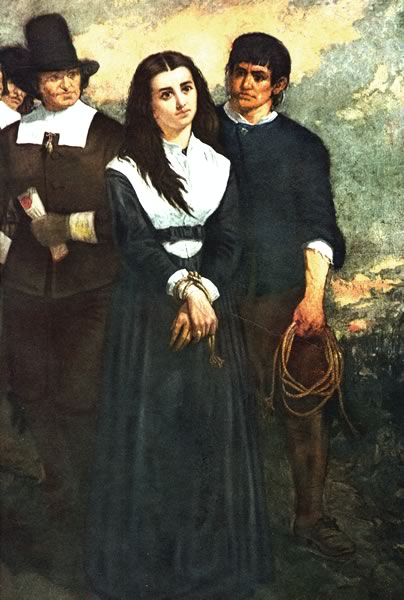
Artist:  Thomas Slatterwhite Noble, 1869, "The Salem Martyr"

I am curious to see whether and for how long this community can tolerate an unrepentant sinner in their midst. Feedback suggests my musical work there is appreciated and greatly enjoyed. "R______ was solid but you are so musicial!" remarked a member after last week's solo debut.

In the fictional account of my sojourn with the Lutherans, on the occasion of some disaster -- busted pipes in the kitchen or a car wreck on the front lawn or ??? -- a funny feeling in one member grows into a whispered suspicion....and then into scattered but muted grumblings
throughout the community and finally bursts forth, blaming the non-believer at the piano for the misfortune.

06 March 2014

In Memoriam

...and I remember now one of the triggers for the awareness of mortality that I blogged about in "Beyond Understanding." It was on the occasion of Barbara England coming to mind. I Googled her and discovered she died. I played piano for her ballet classes a few years ago when I lived in Watsonville CA. She was like French pastry. I didn't know at the time that we shared a birthday. Rest in peace, dear woman. And thanks for the pleasure of knowing you.

 Barbara May England (December 17, 1933-December 19, 2012)

barbara england
Barbara England passed away peacefully on December 19, two days after her 79th birthday. An adjunct dance instructor at Cabrillo College for over 10 years, Barbara was well loved by students and colleagues. A respected dancer, she had a long and varied career that included performing with Matt Mattox and appearances in films such as the Hollywood movie Oklahoma. Her teaching career included Rockland Community College in New York, UCSC and Cabrillo. Barbara's husband, jazz musician and professor J. Carter England, passed away in 2005. She is survived by her sons, Norman and Stuart; her stepdaughter, Leslie Cirillo; and her older brother, Harry Logan. Barbara provided inspiration to many at Cabrillo and in our local community through her dancing, continuous good cheer despite challenges, and her unfailing kindness. (From her obituary at the Neptune Society and reflections by her colleague, Sharon Took-Zozaya.)

Beyond Understanding

I have forgotten the specifics of the trigger but something recently drew my attention to a keen awareness of my mortality. In fact, it hit me like the proverbial "ton of bricks"; I actually had to sit down. In the moment of the trigger, it was as though my understanding of the finality of Death shifted, like one wall of the philosophical, theoretical room of my Comfort Zone fell down and the stark stinging sweaty painful inevitable "gone-ness" of Death was visible for the first time. It had been turning and turning, a surly, billowing cloud on the other side of the wall for a long time. I'd occasionally glimpsed it through a narrow slit window but now I could feel the cold bluster on my face.

Artist:  Stephen Player "Fountain of Youth"
I have often said "I don't want to live forever." Immortality is not the Super Power I would wish for.

"Nobody gets out of here alive" is a favorite adage. Death, being out of my control, is not something I give much thought. What is there to consider? Contemplation of what comes after Life is a game. A mystery. Ineffable.

Fertile ground for the play of artistic exploration. "Here After Here" remains one of the most cherished and valuable of the many artistic sojourns I've experienced.

Although sadness was a tiny emotional component of the breakthrough moment of awareness, mostly I had an expanded sense of and compassion for other people. I thought about my intolerance for the 9-to-5, steady-job lifestyle compared to the pride and devotion some people have for it. For them, perhaps, the work connects to largely unconscious beliefs about Death. Perhaps work is a distraction from painful awareness of their immortality; or it might assuage feelings of frustration or fear:  they are doing their best to leave something behind, a kind of defense against them being unable to exist forever.

I don't want to live forever. The lonely existence of vampires is well-documented. And any work or other enduring vestiges of our time here are merely entertainments for the living. Even if there is a way to know after Death what the living make of us, would we care? Caring about what others think of us seems uniquely attached to the living/breathing human condition. Can you imagine FaceBook in the Beyond?

Concern about the experience of loved ones in the immediate aftermath of dying is fairly universal, at least in the Western mind. So we purchase burial plans and life insurance and compose a Will. It's widely accepted as a necessary courtesy the dead extend to the living. I suspect my minimal concern places me in the minority (again) and is perceived by some as "irresponsible." 

The best I've been able to do so far is to diligently limit the amount of stuff I leave behind. I'm not disturbed by the idea of the whole lot being trashed -- my own body included -- after I breathe my last. I admit it is irresponsible to care so little about the expen$e attached to the disposal; but let it be known:  I will not haunt you if you don't pay any costs that my death incurs. I will not hover restlessly as a moaning ghost. My journey to where- and whatever comes after Life will not be impeded.

I'll be on my way like a whisper. And I wish you sweet dreams and a wonderful life.


19 February 2014

Back in the Day...


February is Black History Month in the U.S. And I could talk about that fact

but not now.

Predating Black History Month, February is also known as Girl Scout Cookie month in many parts of the U.S. I was never a Girl Scout. I suspect my parents just didn't have the time or energy for any more extracurricular activities than the four of us were already engaged in. Beyond that, it would have required my mother to deal with other mothers on a frequent basis and I don't think she was much interested in that.

Cookies didn't appear annually in our house:  with so many overweight adults and children in our extended family, my mother was diligent about limiting the sugar and caloric intakes of her kids. But as an adult whose acquaintances included Girl Scouts and parents of Girl Scouts, cookies were often on my mind come February.

When a CA friend mentioned Girl Scout cookies in a Facebook update this week I realized I hadn't seen a Girl Scout or a Girl Scout cookie in the entire year and a half I've lived in MS. I started talking about it, online and in the real world. Could it be there were no Girl Scouts in Holly Springs? Surely not! One would think in a community with so many churches, there would be several troops. Internet research yielded no listing of a troop in Holly Springs. The closest was Byhalia, about 18 miles away, and the date, time and location of cookie-availability was to be this Saturday. I made a note.

On Sunday, after attending services at the Lutheran church (where I am the new pianist beginning this week), I stood chatting in a small group in the front foyer. Somehow Girl Scout cookies came up. T_____ said he had a cookie connection and would hook me up.

And he did. The Girl Scout in question is a beautiful, precocious 6-year-old girl named Kennedi. She and her mother stopped by around 5 to deliver my cookies. When we spoke on the phone earlier in the day, I mentioned that I taught piano and had openings if her daughter was interested in studying. The piano was the first thing that caught the child's attention when they entered the house.

I asked her if she played and she said her grandmother has a piano and she always plays when she visits. "Splendid!" I said. "I'd love to hear you play if you're up to it." She was shy for a few seconds -- a look at mom and then down at the floor, a little body squirm -- and then she walked to the piano and sat down. With her head tilted and her eyes on the keyboard, I watched her enter "the zone" of music-making.

Using mostly her right hand, she played a longish -- perhaps 35 seconds? -- single-note melodic line. Hand position was outrageous but the musicality was there. The melody was graceful, compelling, with varied dynamics and a satisfying harmonic resolution.

"She's musical!" I said with surprise to her mom. "It's in our family," she replied. "My brother is working on a masters degree in music at Ole Miss."

"Does that song have a name?" I asked. "Did you write it?"

"Yes, I made it up. It doesn't have a name," she responded.

The miniature Etch A Sketch on a side table caught her attention next. After a whispering a request for permission to my housemate (her mother and I were engaged in conversation), she settled into the blue velveteen recliner and ottoman with the toy. One of the first drawings was of a city skyline. "You drew skyscrapers," I commented. "Where did you see skyscrapers?" There are no skyscrapers in Holly Springs. "In Memphis," she informed me. She goes to Memphis once a week for dance lessons.

Later, I asked if I could play piano for them and they said yes. I chose Chopin's "25th prelude," the Op. 45 that I've been working on for several months. While I played, Kennedi found the drawing pad and crayons which reside on the same table as the Etch A Sketch. She drew a picture of a princess bearing the caption (written in cursive!) "You are a princess."


There's so much to notice about this drawing but nothing moved me more than her decision to give the princess brown skin. The sun peeks out of the upper right-hand corner of the drawing much asit did on drawings I made as a first-grader over 50 years ago but brown skin on any figure, let alone a princess? If it ever happened, I don't remember it and it would have been rare. To me it speaks a level of self-confidence and positive self-regard that I would hope for all little girls everywhere.

When I asked her to sign her work, she hesitated. "I want to take it with me," she said. "Oh, we can make a copy if you like. This is my guest book -- it has to stay here." So she accompanied me and I showed her how to make a copy. She wasn't pleased with the results; the color was off and needed retouching. We returned to the living room and she set to work with crayons to correct the color values while the adults continued talking.

It was during this part of the conversation, in response to my query about whether school was providing ample challenge and encouragement for a student as advanced and eager as her Kennedi, that she confessed the "down" side to her daughter's multiple gifts:  she gets in trouble at school for "talking."

Ouch! Though it rarely happened, I well remember the sting of being reprimanded in class for talking. I also remember my mortification on the long walks home from school carrying a report card with lower than an "A" in "Conduct", with a note from the teacher about "talking."

By now Kennedi had finished her touch-up of the photocopy and was standing near her mother. Her mom looked at her as she shared with me the story of Kennedi's progression from one color group to another -- I think it was from blue to red...to "you know what comes next," she said ominously, looking sternly at her daughter, who was by now bent backward over the arm of the sofa and squirming. Mom turned her lower torso slightly and smacked herself once on the butt. "You know..."

 "Mommy...." Kennedi whined.

"Oh, wasn't I supposed to tell anybody about that?"

"Well, it is rather embarrassing," I offered.

"They're still doing that?!" asked C___________, his shock only barely masked. Mom allowed that yes, they are; although after a bit of controversy a few years ago, she added, the schools adopted a policy requiring parental permission (I think in writing....) to apply corporal punishment. She said she didn't want to "have to" do it but she had felt she was losing control of the situation. "I just figured that if I was doing it at home and they were doing it at school, together we'd be able to correct the problems."

Ah, yes. I remember corporal punishment from school days, too. I never received a spanking at school. I knew kids who did and in my mind it was no less unique and mysterious an experience than flying to the moon. My parents were vehemently opposed to anyone else striking us and made it known in unequivocal terms at the beginning of each school year. I think they were especially disturbed by the prospect of a white person hitting us. Based on my limited experiences in the schools here as a substitute teacher, better than 70% of the teachers are black. I don't know what part, if any, race plays in the willingness of parents to let other people hit their children.

Artist:  James R. Eads
I am sad but not surprised to hear that in Holly Springs it is still widely acceptable for large people to hit small people as long as the small people are children for whom they have responsibility. It's sad and disappointing and frightening to see that this culture of violence against children yet persists in the 21st century; to encounter a consciousness that could condone violence, for any reason, toward a child as physically beautiful, cognitively vibrant and spiritually intact as Kennedi.

I didn't launch into my thoughts and feelings about corporal punishment yesterday. It is mostly none of my business. Still it seems my business if I think of us as coexisting in an interdependent web or think of myself as an elder with a kind of mentoring responsibility toward this young mother and little girl. Perhaps she will enroll her daughter as a piano student with me. If she does, there will likely be opportunities to invite her to rethink the hitting-as-a-way-of-teaching approach to parenting.

It's been a pretty long time since I knew anyone who hits their children. Bumping into this archaic and barbaric holdover (or throwback) from less-enlightened days triggers a fantasy of how the last five dinosaurs might have looked to new-and-improved life forms. "What?! Wow.... I thought all you guys were gone by now..." 


18 February 2014

What A Little Sunlight Can Do To You

The sky is blue. The sun is shining. I'm on the back porch without gloves or scarf. And sometime in the next hour or so, Girl Scout cookies will be delivered to my door.

It's been a rough Winter in many ways. Harsh realities have abounded, reminders of the vulnerability and limitations of the Human Condition.

I've found it difficult to write and given up trying.

The beautiful weather today offers a renewal of spirit...and a reminder of the transience of all things.  Seasons of cold weather, depleted bank accounts, grief, loss. They present and cycle through and are replaced by balmy sunlit days and new opportunities and birth.

Artist:  Adam Wicinski, "Light & Shadow Study XX"
Seasons of Light and seasons of Shadow. Inextricably bound. Interdependent:  each defined by the existence of the other.

I Google "light and shadow" and the search results bring Haruki Murakami into view again. He writes:

“Where there is light, there must be shadow, where there is shadow there must be light. There is no shadow without light and no light without shadow....

Like everybody else, in the grips of cold winter or dark days, I wish for warmth and light. I want things to be different. In the relentlessly even climate of northern CA I yearned for lightning and thunder and scorching heat. 

There's no error in this tendency to yearn. To abandon the here and now to dream of something different. It's just the way we are. 

It is also good to remember


This storm, this darkness, this Light:  they are seasons of Life.  Things change and change us as they do. Resistance or denial of the inherent mutability of existence is, as the Borg insists, "futile."

Where I mean to place focus is on the practice of maintaining awareness, of willingly bearing witness to our Lives...and the changes...and the cycles. I call it "Staying Awake" and it partners with "sojourn" and "improvisation" in my mind.  Each place of cold or dark or light or warmth is a site of sojourn, for body and mind; they will not last forever; we will only be there for awhile. In each site, we make it up as we go along. We stay awake and respond, interact, react; initiate, manipulate, attempt, .... 

I continue to suffer the barrage of happiness encouragement I find in my Facebook news feed. Those friends who are most enamored of contributing these posts that advocate unbridled joy and unending positivity, comprised of scenes of gorgeous sunsets or startlingly brilliant Photo-Shopped  bouquets accompanying words written by someone else, are sequestered in a cyber group I call "Happy Happy" so I don't have to look at them until I want to. (Some of this group are also filed under "Prolifics.")

Yesterday I found the following post in the "Prolifics" group:


...to which I added the Comment:

Alex Mercedes Better days are here!
I appreciated the two "Likes" the Comment received. This affirmation, like many others, seems in that vein of wishing things weren't the way they are.
Things are the way they are. A "better day" may never come or it may come after we're gone.  
We have this day. The only day we have for sure. And it has the shape it has. What's happening is happening and we are here in it. Being changed by it and impacting it.  

The practice is not about wishing for a "better day" and it is not about learning not to wish for "a better day." It's about staying awake:  to our wishing, as well as the reality that we're wishing to escape. It's about an Awareness of the eternity within which wishing and not wishing, light and dark, Winter and Spring and all the other dualities....and all the space between and beyond dualities exist.


****************************************
The sun is low in the western sky now. I haven't spent this much time writing in a long time. Ooooh, ooooh, ooooh....what a little sunlight can do to me.


02 February 2014

God or Me or Somebody Needs An Answer

It's cold again.

Talking about the weather is one of my least favorite pastimes        but

It's cold again. At this point I am done with COLD:  enough already, sayonara baby get outta here!  Twelve hours ago I was standing barefoot on the front porch with the first stirrings of sultry rippling across my skin. I looked at the lawn and imagined myself pushing the mower...and sweating...and I smiled. I was standing alone in the dark and smiling 12 hours ago...

Fast forward. Sunday morning. Rain. Wind. Falling temperature. Joints chilled. Shoulders tight and hunched. I am well aware of the uselessness of complaint. So let's move on...

I drove out to Grace Lutheran church this morning to listen to the service. I am considering an offer to become their Sunday morning musician. I left home early enough to stop by Christ Church before anyone arrived and leave a final donation -- and key to the back door -- in a specially-designed "Miss Alex Piano Studio at Christ Church in Holly Springs" envelope. (I saved the Word template but destroyed all but one of my printed stock last night....such drama...)

There was only one car parked in the lot when I arrived. Sarah L_____, a member of the congregation, and I met for the first time last Monday at the courthouse. We were both summoned for grand jury service (she was selected; I was not). She recognized my name when it was called aloud by the clerk (a most agreeable woman) and introduced herself during a break. She knew I played and taught piano from her brother, Tim (who knows me a little from local political meet-and-greets) and she wondered if I'd be interested in replacing their current pianist who is moving to Kansas at the end of February. She told me they are a very small group and are fine with singing to recorded music in a pinch.

I entered the church. Very sweet, inviting front hall. Well lit. Lots of light wood and white walls and simple lines. Inside the sanctuary, seven or eight rows of chairs extending to either side of a center aisle. A pair of protruding knees were visible above the seat backs of the second row from the back. A few more steps forward and I saw a very tall -- perhaps 6'8" or greater, very pale-skinned, dark-haired, 20-something man reclined, wearing small white earphones.

He sat up when he saw me and said hi. "Hi," I responded and took a seat on the opposite side of the aisle in the last row.  Within a few minutes a woman arrived and walked briskly to the piano. I liked her portfolio cover:  b&w/gray tone image of a sheet of manuscript with music inscribed; from a distance it looked like zebra skin.

When our eyes met I walked over. We introduced ourselves and talked a little about the Lutheran music and liturgy.  As I returned to my seat Sarah L_______ entered from a door behind the pulpit that likely leads to the sacristy; she was carrying a communion wine tray and a large white cloth. She placed them on the alter against the back wall and genuflected before coming down to greet me.

In my memory everyone else arrived all at once then:  an older couple (probably my age but "older" than me in that way that married people sometimes are), Tim and Lisa L________ (brother and sister-in-law to Sarah), the minister, and another middle-aged woman entered the room within seconds of each other. It is time for church I thought. And everyone looks so.....sturdy...and white, I thought.

The pianist played a brief prelude that sounded like a slightly embellished hymn. And it may seem a strange observation but after spending a few days with the hymnal Sarah dropped off earlier in the week, it occurred to me this morning, with a certainty akin to sensing a gentle spirit in someone I've just met, that the people look like the music they sing in worship, both as it looks transcribed on the page and as it sounds when sung.

Both are the precise opposite of "elaborate." Both exhibit a steadfast passion:  not the  passion that flares and excites, rather the passion that burns without flame, smolders; banked embers that continue to radiate heat while holding the promise and possibility of igniting a future flame.

It was Communion Sunday which, as is true in many faith traditions, is celebrated with a longer and more complex liturgy, the details of which are not in the main relevant to this report. As in many Catholic services I attended as a girl, the piano accompaniment takes the form of a prompting support for singing. There is no ornamentation. No pianistic virtuosity or lyricism. Sustained chords while singers unwind melody lines that seem intentionally composed to avoid triggering emotion. In the liturgy, minister and congregants express in call-and-response interactions with spoken and sung texts intermingled.

Texts express praise. Mostly of God and Jesus; minimal mention of Mary; isolated reference to Spirit except as it imbues the words and actions of God and Jesus -- as contrasted to Pentecostal communities where celebration of Spirit is the core of their worship.

Two other observations worth sharing:  One:  Standing and sitting and standing. And standing a lot (yes, it's relative; in this case to Baptist or Methodist or perhaps, even, "black" church services). For me, these exertions in combination with the singing provided a welcome physical balance to the staunchly mind-oriented components -- language, thinking, listening, etc.-- of the ritual.

Two:  When we spoke last week, Sarah assured me there's no requirement for the pianist to be Lutheran. I didn't press for a similar assurance if the pianist is also not a "believer." I didn't want to manufacture obstacles to accepting the invitation. I enjoy sacred music; I could use the gig; the idea of getting out of bed early every Sunday also appeals; and opportunities to meet people here are too few and far between to carelessly brush one away.

Somewhere during the service I began to feel like the Devil in their midst....a wolf in sheep's clothing....an interloper (the definition of which reads "
1.  a person who interferes or meddles in the affairs of others: He was an athiest who felt like an interloper in this religious gathering.)
Vampire Interloper | Art by James Ryman
 Hymns like "Stand Up! Stand Up for Jesus", "The Church's One Foundation", and "Jesus Shall Reign Where'er the Sun" combined with commentary from the minister along the lines of "We are all unworthy sinners. Every hour surrendering to the forces of evil that surround us..." provoked a growing sense of unease.

Reminded at least 10 times during the 75- minute service, in a variety of ways, that we are surrounded by evil, that we are unworthy, that God and Jesus are our only hope and  Heaven is only open to those who confess their wickedness, ask forgiveness and swear allegiance to Jesus.

The sermon title was "Look & See, Duh" as in "It's apparent, unquestionable and simple: Jesus is the Son of God! If you don't get it or don't believe it...well, duh...what's wrong with you?"

Even in this dispassionate community of faithfuls, the drums of evangelical warfare echo, impelling believers into a competitive struggle with the world, based on ideological difference. I had a sudden gripping understanding (again) of why conversation with religious fanaticism is impossible. Quiet fanaticism is fanaticism all the same.

The rejection of difference and a will to subjugate all difference are among the features I find most challenging and unattractive about mainstream, organized religion. Does the world need more rejection and subjugation? I say "no."

Without calling our names, the minister made it plain in his Preface to Communion that John (the long-legged young man) and I were welcome to come forward and share the "bread and wine" (it occurs to me as I type quotation marks that I have just typed a euphemism for a euphemism...or is a metaphor for a euphemism?....or...). We were the only two who did not participate in the communion ceremony.

"Moment of Truth" by Joel Rea
Near the end of his sermon, the minister walked away from the podium, clearly enjoying this scripted digression from the usual form, to ask us to consider what it would be like to have Jesus suddenly manifest in the flesh right in front of us, looking us in the eye, talking to us.

A fat moment or two of silence followed to allow our imaginations to engage with that idea (longer-than-usual-silences are one of my favorite tools when I'm teaching or leading workshops so this was one of the rejuvenating spaces in the service for me). "Well," he finally said. "You don't have to wait or imagine. Jesus is that close to us all the time but we're usually distracted and not paying attention. He is always offering us the unconditional love and forgiveness of the Lord of heaven and earth."

In the pregnant pause, contemplating the idea he offered, I felt an expansion of sensorium, partly joy but mostly a feeling of relatedness and access to everything, everyone, everywhere, forever. And after he delivered the "punch line," my first literal thought was "Yes!...So, why are we still sitting here? and why are you still talking? and why would I draw (and patrol) a dividing line between me and anybody or anything else in this vast, wondrous Creation?

That inquiry resides in a space accessed by stepping off the cliff edge of Christian obedience. To reach the Inquiry and swim it, a believer must take a crucial first step that is, often, expressly prohibited. Even acknowledging that the inquiry exists, that neighbors, friends, children have taken the plunge and are willfully engaged with the inquiry is defined as problematic.

&&&&&&&&&&&&&&&&&&&&

I brought the hymnal home with me. I am thinking of going back next Sunday to observe the musical outline of a non-Communion liturgy; and also, finally, to ask how much they're paying. (I got the telephone number of the outgoing pianist today and may call her with this question; Sarah and I have avoided the topic altogether so far...).

My fear, i.e., the worst that could happen if I accepted the gig, is that I won't find enough ecumenism and cosmic holism to counterbalance and "sanitize" the solid, white, plain, besieged-beleaguered-and-vile flavors I observed today and getting up early on Sunday to drive to the edge of town becomes a drag. Plus, they're nice people and I wouldn't want to accept only to resign after a short time and leave them in the lurch.